Pressure Washer Nozzle Size Calculator
Find the right pressure washer nozzle orifice from your pump GPM and PSI, see the next stock size, and check the PSI the chosen tip yields.
Enter your pump's flow rate and pressure to size a nozzle.
Closest stock size
–
orifice = GPM x sqrt(4000 / PSI)
How?
How this is calculated
The orifice size designation equals the GPM that flows through the opening at 4,000 PSI (the reference pressure used by nozzle charts). At any other pressure the relationship is:
A larger orifice at the same GPM reduces pressure; a smaller one raises it. The calculator finds the exact orifice, snaps to the nearest stock sizes above and below, and shows the actual PSI each stock nozzle produces at your pump's flow rate:
PSI_actual = 4000 x (GPM / nozzle_size)^2 Unit conversion constants: 1 GPM = 3.785411784 L/min (exact definition); 1 bar = 14.50377 PSI (NIST). The metric toggle converts L/min and bar to GPM and PSI before computing the orifice number.
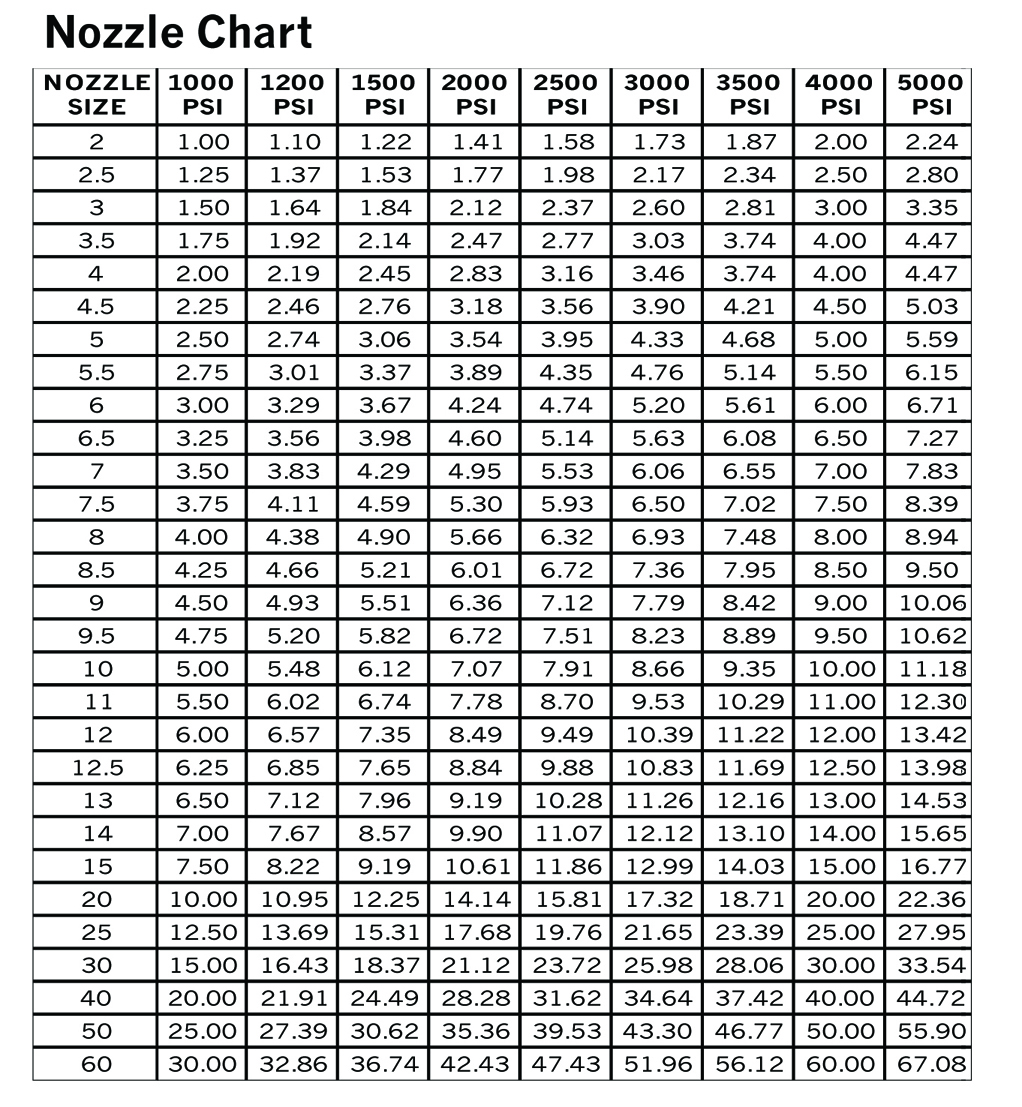
Source: EnviroSpec nozzle chart and technical library; every chart cell equals size x sqrt(PSI / 4000).
Formula: orifice = GPM x sqrt(4000 / PSI)
Enter your pump’s GPM and PSI and this calculator returns the exact orifice number, the nearest stock nozzle sizes above and below, and the actual PSI each stock tip produces at your flow rate.
The formula behind every nozzle chart. The orifice size designation equals
the gallons per minute that flow through the opening at 4,000 PSI. At any
other pressure the relationship is
orifice = GPM x sqrt(4000 / PSI). Most published nozzle charts are just a
grid of this equation, but they force you to interpolate between rows instead
of giving you the number directly. This calculator solves the formula, snaps
to a real stock size, and shows the trade-off: moving up one size drops your
working pressure; moving down raises it.
What the part number means. The first two digits on a quick-connect tip are the spray fan angle in degrees (0, 15, 25, 40, 65). The remaining digits are the orifice size: whole sizes show the number directly (06 for a #6), while half sizes use the size times ten (035 for a 3.5). A tip stamped 25035 is a 25-degree fan with a 3.5 orifice; 2506 is a 25-degree fan with a #6. The calculator builds the sample code for each stock size so you can order without decoding a chart.
Metric toggle. Switch the inputs to liters per minute and bar. The calculator converts L/min and bar to GPM and PSI first, because the orifice size is defined as US GPM at 4,000 PSI.
Worked example (EnviroSpec TS2021 pump). A TS2021 delivers 5.6 GPM at 3,500 PSI. The formula gives an exact orifice of 5.99: the calculator rounds up to #6, which yields about 3,484 PSI at that flow rate, matching the EnviroSpec chart. The next size down (#5.5) would push calculated pressure to about 4,147 PSI, above the pump’s rating, so the unloader valve would bypass some water and actual flow would drop to roughly 5.1 GPM.
For job pricing once you have the right nozzle, see the pressure washing estimate calculator. Chemistry for a soft-wash rig that uses these same tips is in the soft-wash mix and dilution calculator. Track your nozzle, hose, and machine costs per hour in the equipment cost per hour calculator.
This is a sizing worksheet, not an equipment specification. Verify the orifice, fan angle, and thread type against your pump’s documentation before ordering. Nothing you enter leaves your browser.
Sources
- Nozzle Chart and Technical Library. EnviroSpec. Retrieved .
- Nozzle Chart Image (stock orifice sizes 2 through 60). EnviroSpec. Retrieved .